01
Filming
- HoloLens B-Roll
Project overview
I had the chance to help tell the story of CAE Healthcare's HoloLens training experience, a piece that needed to show how augmented reality is reshaping medical education. The challenge was to communicate a genuinely new idea: that learners can now study anatomy and practise procedures on plastic and pixels, seeing finite anatomical detail standing in mid-air rather than flat on a textbook page.
The video needed to make that leap feel real and tangible for the people it matters to most (educators, students, and healthcare providers) while connecting the technology back to its purpose: safer practice and better patient outcomes.
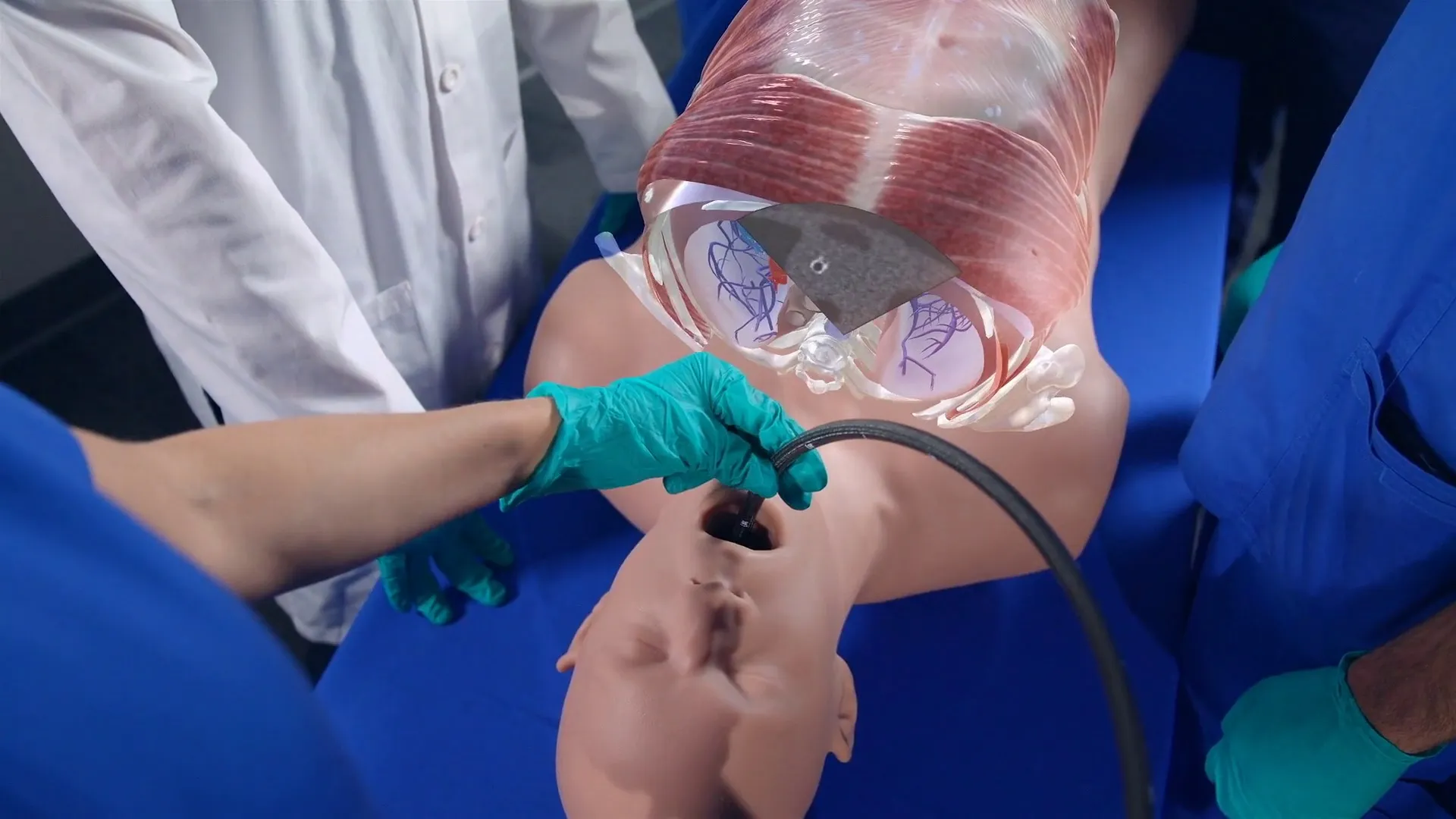
I got to take a HoloLens home to really understand the experience before shaping how it would read on screen, and that hands-on time informed every creative choice. I captured b-roll of the technology in use, then animated the HoloLens screen experiences with meticulous attention to detail so viewers could see exactly what a learner sees inside the headset.
From there I edited the footage into a narrative-driven video and cut it down for multiple social platforms, tailoring each version to where it would live. The result showed how cutting-edge AR is transforming medical education, empowering healthcare providers, and ultimately improving patient safety.
CAE Healthcare is the global training partner of choice to improve patient safety, and we do that by providing the most innovative training solutions based on simulation. Our customers are university, colleges, governments, medical device companies, hospitals. For centuries, people were relying on textbook and dissection and plastic models of the heart. And in a span of twenty years, we've seen that augmented reality on a two d screen. And now what HoloLens has added is another layer. You're not looking at the augmented reality on a two d screen. It's there, standing in mid air. And now you can see these finite details, the relationship with many structures, and you can see them with all the range of what's normal, but also with pathologies. So that's been a revolution. What we see in this generation of learners is that they come to the classroom with a different set of skills, eager to interact with technology, eager to to be immersed in their learning environment. As a healthcare provider, we're the most dangerous when we are into that learning curve. But now this has completely changed. We can practice on plastic and pixels and try things and make mistakes and see also all the different cases and the different challenges you can have. And then when you're ready, you really can go at the bedside and do these procedures on real patients. Within a space of two, three weeks, we were up and running. We were displaying physiology into the HoloLens world there. It was spectacular. And the HoloLens, because of its optical characteristics, the doctors viewing the internal tissues in the organ at the working distance between eyes and hands, you need extreme accuracy for that. HoloLens offers that. The educational framework that we can add in this virtual environment is limitless. Now, you're going to have the best teaching or learning experience ever, and you can do that remotely. So everybody is in the same virtual environment with the exact same world renowned instructor, for example. It's been proven in other fields that simulation actually leads to safer environments. We're bringing this technology to our students so that they're gonna be better healthcare providers.